
Lisa Sonni

Peter Salerno

You may understand what’s happening.
You may have talked about it in therapy.
You may have separated.
You may have tried to leave.
You may even know, logically, that this relationship isn’t what you want.
So why do you still feel pulled back?
Why do you still miss him?
Why do you still question yourself?
Why do you still wonder if maybe things could change?
And why does moving forward sometimes feel like you’re fighting against yourself?
Trauma Bond Recovery Group Coaching is designed to help you understand the bond, rebuild trust in yourself, and begin breaking the patterns that keep pulling you back.
Maybe you’ve tried to leave before.
Maybe you’ve already left.
Maybe you’re still in the relationship but emotionally exhausted from trying to make sense of it.
Maybe everyone around you keeps asking:
“Why don’t you just leave?”
And you wish you knew how to explain that it’s not that simple.
Because knowing something isn’t healthy and being emotionally free from it are two very different things.
One woman who found this work had already done everything people say “should” fix the problem.
She left.
She finalized the divorce.
She started going to therapy.
Yet she kept finding herself pulled back into the same chaos.
“I was already divorced, but it felt like there was this invisible force pulling me back over and over again.”
Her therapist told her she was trauma bonded.
But when she asked how to break it, the answer was frustratingly vague.
“They told me it would take time. But I had already been divorced for a year. Time wasn’t working.”
If you’ve ever thought, “I know better, so why can’t I just move on?”—you’re not alone.
There is a reason this can feel so much harder than it looks from the outside.
Over time, this can drain your energy, cloud your instincts, and make decisions that once seemed obvious feel incredibly complicated.
This is why “just leave” isn’t always the answer.
The deeper work is learning to understand the bond so you can stop fighting yourself.

Many women come into this work asking:
“Am I overreacting?”
“What if I’m wrong?”
“Maybe it’s me.”
“He is nice sometimes, so does this really count?”
“What if I just communicated better?”
“What if he really does change?”
“Why can’t I stop thinking about him?”
They aren’t necessarily looking for more information about relationships.
They’re looking for something deeper:
And that is where the work begins.
Because the goal isn’t to teach you to depend on someone else to tell you what your relationship means.
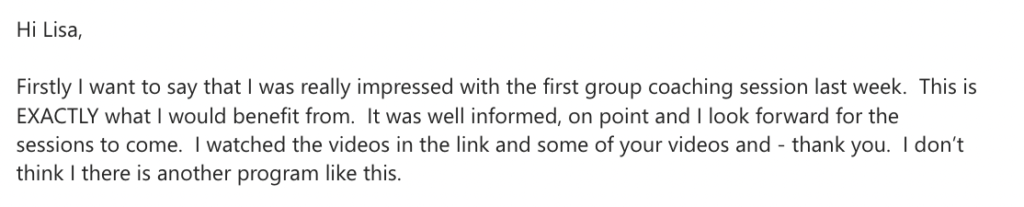
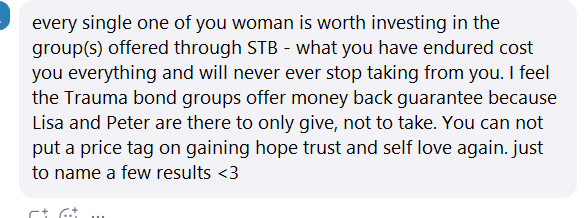
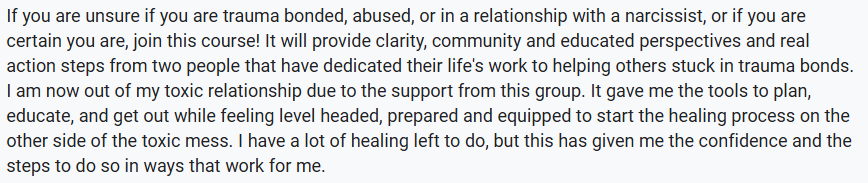
Inside Trauma Bond Recovery Group Coaching, you’ll begin to understand why you feel pulled back instead of continuing to blame yourself for the pull.
You’ll learn to recognize the patterns.
You’ll begin looking at behavior instead of getting lost in intentions.
You’ll begin separating reality from potential.
You’ll begin understanding what you’re actually grieving.
And, little by little, the focus starts shifting.
From:
“Why does he do this?”
to:
“What do I need?”
From:
“Does he love me?”
to:
“What does he consistently do?”
From:
“Maybe I misunderstood.”
to:
“What actually happened?”
From:
“How do I make him understand?”
to:
“What do I need to do to protect myself?”
And from:
“What happens if I lose him?”
to:
“What am I building now?”
One of the most powerful parts of this experience is realizing:
You are not the only woman who has felt this way.
Women in the program repeatedly describe the impact of hearing someone else put words to what they’ve been experiencing.
The confusion.
The self-doubt.
The hope.
The grief.
The pull.
The difficulty letting go.
The feeling that nobody else quite understands.
And then someone says something in the group and you realize:
That’s me.
I’ve felt that too.
I’m not the only one.
That experience matters.
Because healing doesn’t have to happen in isolation.


Not more endless analysis.
Not another cycle of leaving and returning.
Not another attempt to get him to finally understand.
Week 1
Understanding Your
Trauma Bond
Understand what is happening and why the pull can feel so strong.
Week 2
Living in
Reality
Begin separating what is actually happening from what you hope will happen.
Week 3
Letting Go of
the Potential
Begin releasing the version of the relationship you have been waiting for.
Week 4
One Day at
a Time
Learn to work with the process without demanding that you have everything figured out at once.
Week 5
Owning
Your Feelings
Reconnect with your emotions instead of judging yourself for having them.
Week 6
Self-
Compassion
Begin changing the way you speak to yourself about your choices, reactions, and recovery.
Week 7
Grieving
the Loss
Make space for the relationship, future, security, family, or version of life you may actually be grieving.
Week 8
Acceptable vs Unacceptable Behaviors
Get clearer about what you will and will not participate in.
Week 9
Understanding
Your Needs
Shift the focus back toward you and what you need.
Week 10
Rebuilding
Your Future
Begin imagining and creating a future that isn’t centered around fixing the relationship.
Week 11
Creating Your
Support System
Build connection with people who can support you as you move forward.
Week 12
Self Love
and Confidence
Strengthen your relationship with yourself and begin moving forward with greater self-trust.
You’ll have spent 12 weeks practicing how to:
And that’s not the promise.
You may still have hard days.
You may still feel grief.
You may still miss certain things.
You may still feel scared about the future.
But you can understand what is happening.
You can stop needing someone else to prove that your experience was real.
You can begin trusting your own perception.
You can learn that missing someone doesn’t automatically mean you should go back.
You can recognize that sometimes what you’re missing is:
security.
familiarity.
companionship.
relief.
the future you imagined.
the version of him you kept hoping would appear.
And when you can understand what you’re actually grieving, the grief becomes something you can move through.
At the beginning, so much of your attention may be on him.
His behavior.
His intentions.
His feelings.
Whether he will change.
Whether he understands.
Whether he loves you.
Whether you are justified in leaving.
Whether you’re making the right decision.
The work gradually brings that attention back to you.
What do I know?
What do I need?
What is acceptable to me?
What protects me?
What do I believe?
Who supports me?
What do I want my future to look like?
Not becoming someone who never feels anything again.
Lisa Sonni is one of the most recognized voices in the world on trauma bond recovery, abusive relationships, and rebuilding after emotional and psychological abuse.
A 5x author, certified relationship coach, and trauma bond recovery expert, Lisa has built an educational platform of more than 1.6 million followers by helping women understand why they stayed, why leaving felt so hard, and how to rebuild the parts of themselves the relationship tried to erase.
But Lisa does not teach this work from theory alone.
After breaking her own trauma bond, she learned firsthand that leaving the relationship is not the same as feeling like yourself again.
The deeper work is rebuilding your identity, trusting your own voice, reclaiming your power, and creating a future that finally feels like yours.
Through her books, coaching, courses, group programs, and live events, Lisa has helped thousands of women move from confusion, self-doubt, and survival mode into greater clarity, self-trust, independence, and a life they no longer have to shrink to survive.

Dr. Peter Salerno, PsyD, LMFT, is a psychotherapist, author, and trauma-informed educator specializing in complex trauma, narcissistic abuse, trauma bonds, and pathological relationship dynamics.
With decades of clinical experience, Dr. Salerno has helped thousands of survivors understand the deeper psychological impact of abusive relationships, from trauma-based belief systems and emotional dysregulation to self-doubt, shame, attachment wounds, and the loss of personal identity.
His work bridges clinical expertise with grounded, practical education, helping survivors make sense of what happened to them and why it has been so hard to move forward.
Through his books, clinical work, education, and live teaching, Dr. Salerno helps women rebuild emotional stability, self-trust, confidence, and the inner safety needed to create a life beyond survival.

Upcoming Cohorts
Your program includes:
Complete Satisfaction Or 100% Of Your Money Back!
Further payment plans available upon request.
For full terms and conditions, click here.
You don’t have to have everything figured out.
You don’t have to be completely detached.
You don’t have to stop caring overnight.
You just have to be ready to understand what’s keeping you stuck and begin choosing yourself differently.
Trauma Bond Recovery Group Coaching gives you 12 weeks to do that work—with guidance, structure, and women who understand.
And begin creating a life that isn’t organized around the relationship anymore.
In a nutshell, Trauma Bond Recovery Group Coaching is a 12-week program designed to help you understand why you’re still emotionally pulled toward a relationship you know isn’t healthy, rebuild trust in yourself, and begin breaking the patterns that keep you stuck.
You don’t have to figure out the rest of your life today.
You just have to take the next step.

